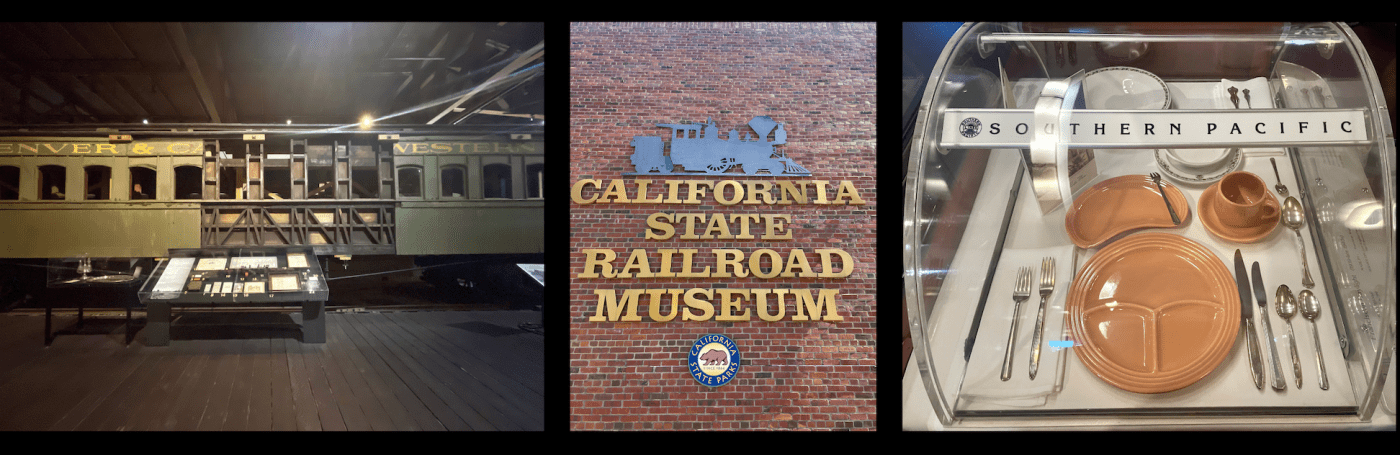
As someone who has been posting “This Day in LA History” for 16 years, I’m always amazed when circumstance places me in a location on the exact day of an anniversary relevant to that site. It’s happened more than a few times and I love when these history stars align.
The history stars aligned again on May 10, while I was strolling along the creaky wooden boardwalks of Old Sacramento, waiting for the California State Railroad Museum to open.
On 2nd Street, I saw the large stone monument to Theodore Judah, the engineer responsible for 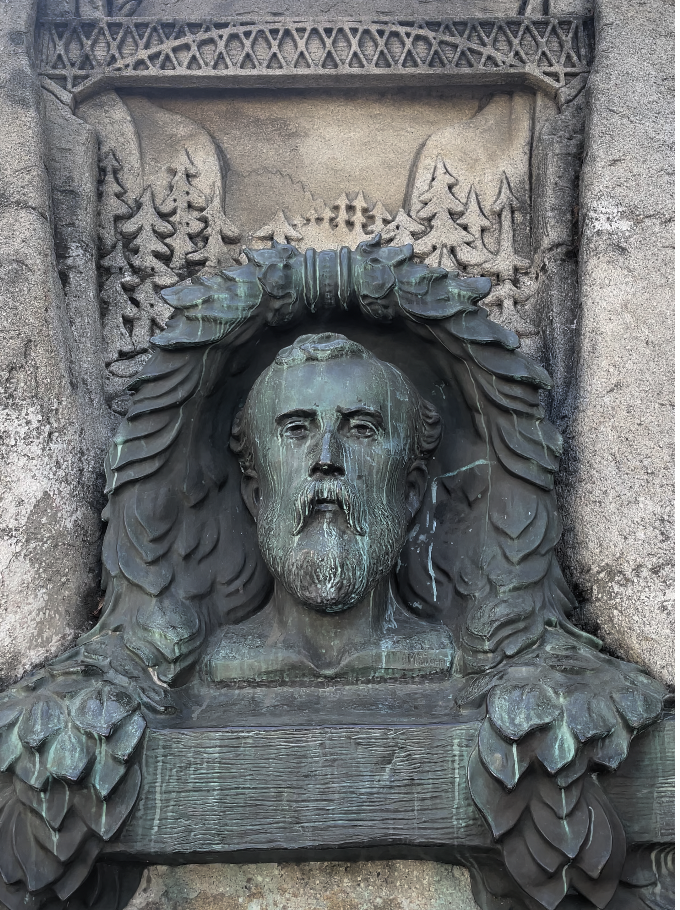 plotting the western route of the Transcontinental Railroad. The last line of his monument read, “The road was built past the site of this monument over the lofty Sierra, along the line of Judah’s survey — to a junction with the Union Practice at Promontory, Utah, where on May 10, 1869, the ‘Last Spike’ was driven.”
Ahhhhh! That was the moment I remembered that May 10, 2025 was Train Day*, the anniversary of the golden spike ceremony in Promontory, Utah that marked the completion of the nation’s first Transcontinental Railroad. This moment in 1869 meant that a trip between New York and San Francisco now took about a week, instead of the months-long boat trip around South America or across the Isthmus of Panama.
Not sure how the folks in Old Sacramento celebrated that day 156 years ago**, but I was unintentionally going to celebrate by exploring the California State Railroad Museum.
So I’m jotting down a few of my train museum highlights here to help jog my memory later:
“Her fingerprints are on the building of the Transcontinental Railroad.” – Christine L. Pifer-Foote
Married to engineer Theodore Judah, Anna Judah accompanied her husband on his surveying trips through the 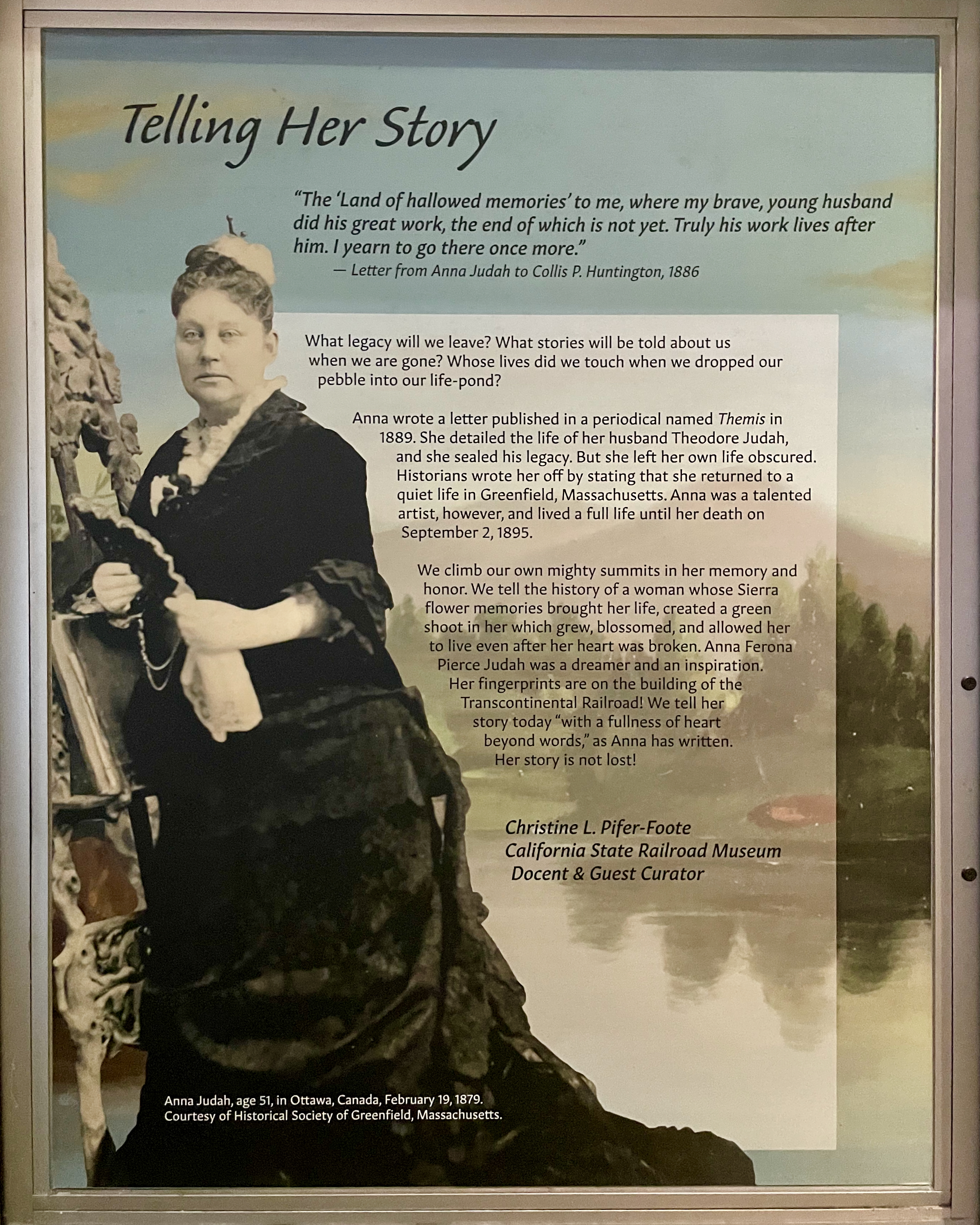 Sierra Mountains. She brought along her supplies for painting and pressing flowers. The museum’s exhibit “Painting A Legacy: The Search for Anna Judah” had just closed but there were still a few displays up about her influence to sway Congress to support the Transcontinental Railroad. In discussing Judah’s watercolors and pressed flowers, curator Christine L. Pifer-Foote explained, “Their importance lies in their impact on railroading history. When they were displayed in the U.S. Capitol, they helped convince skeptics in Congress to vote for the Pacific Railway Act of 1862.”
Collis Potter Huntington in Sacramento:
With a mom who worked at the Huntington Library over two decades, I am well-versed in Henry Huntington’s family history, including his famous uncle, Collis P. Huntington. But I did not know he worked and lived in Sacramento, specifically 54 K Street.
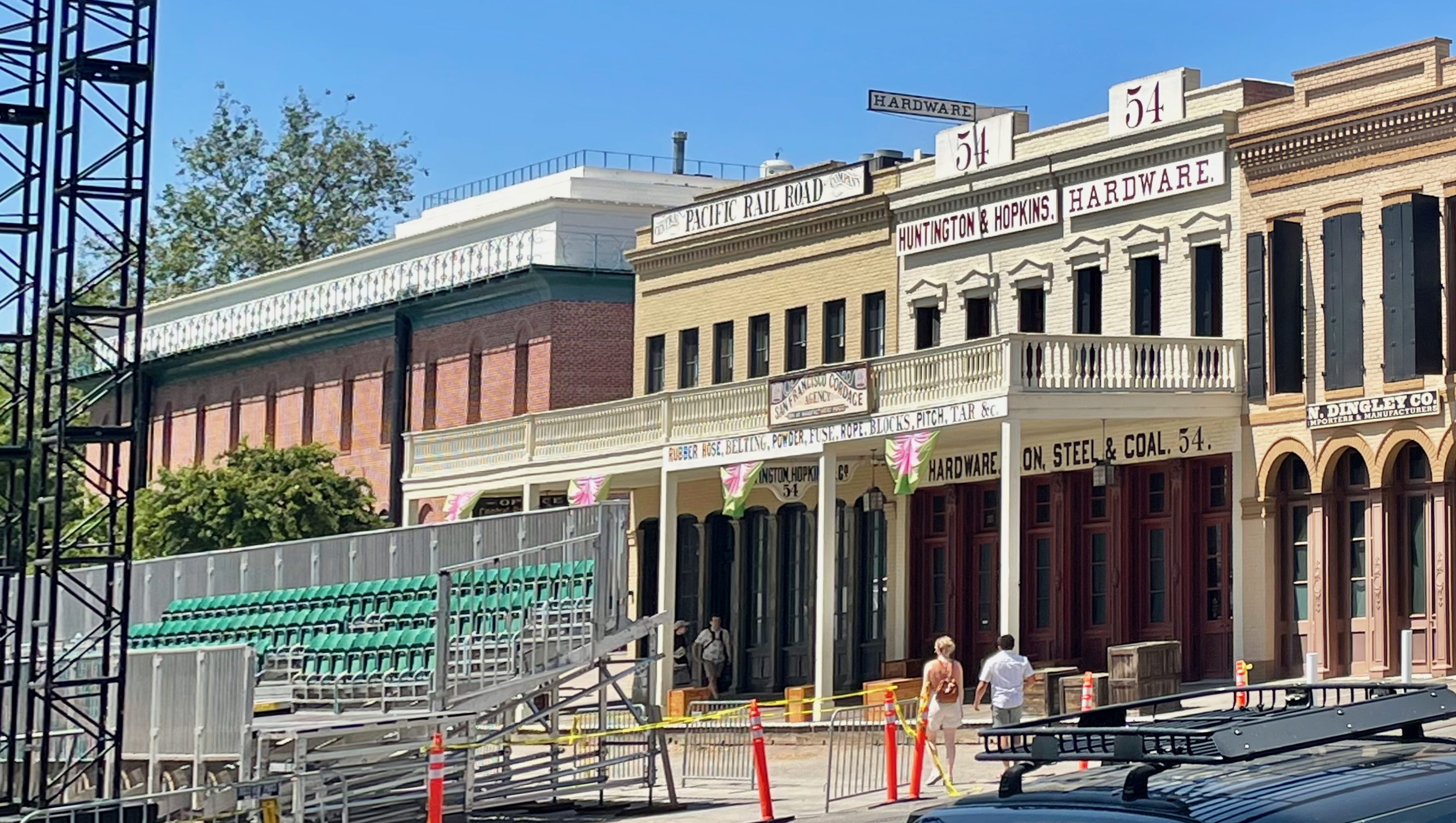
It’s here that he partnered with Mark Hopkins to open Huntington and Hopkins Hardware, a store that outfitted miners on their way to Gold Country. The second floor of the original building is where the “Big Four” initially operated the Central Pacific Railroad Company, the railroad that would complete the western leg of the first Transcontinental Railroad. The original building was demolished for the 5 Freeway and recreated in 1970.
C.P. Huntington Steam Locomotive: This 1863 locomotive was originally built for the Central Pacific Railroad to transport passengers and materials for the Transcontinental Railroad. The Southern Pacific inherited this engine and renamed it C.P. Huntington Locomotive #1 in honor of the company’s third president. Out of commission in 1914, the locomotive made ceremonial appearances at exhibitions around California including the opening day of Los Angeles’ Union Station in 1939.
Chinese Workers of the Transcontinental Railroad
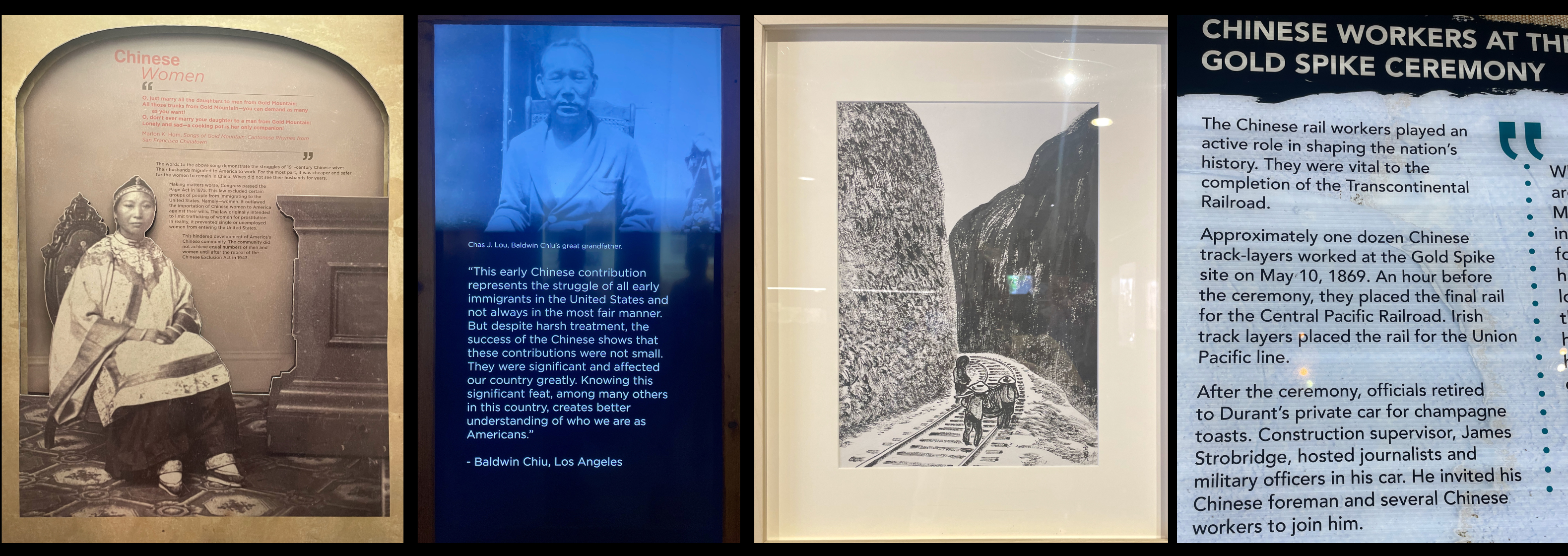
Appreciated all the displays throughout the musuem about the railroad’s Chinese workers — ranging from historic photos to quotes to artists’ present-day artwork — all in honor of those who endured the back-breaking work of building the Transcontinental Railroad. My photo collage above might be a bit hokey, but I wanted to remember all the different ways their stories were presented. Frankly, I’d love to see more museum stories about the laborers responsible for building our large infrastructure projects.
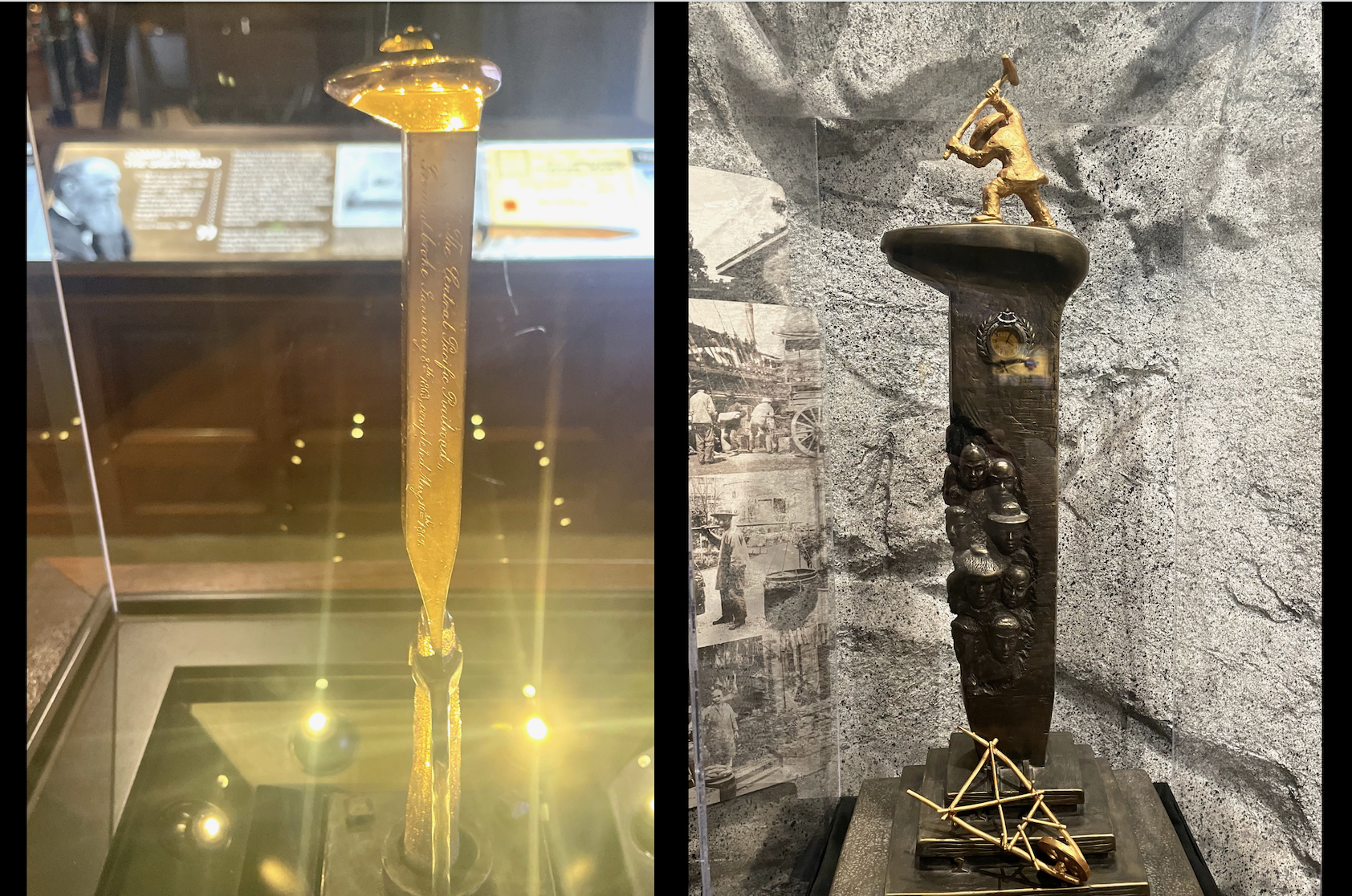
Ceremonial Spikes of the Transcontinental Railroad
My mom and I had a number of conversations about ceremonial gold spikes — the one at Lang Station and the one in Promontory, Utah. If unfamiliar, these golden spikes were ceremoniously used to signify the last spike of a new railroad. The golden spike at Lang Station celebrated the the railroad’s connection between Northern and Southern California and was in the archives of the California Historical Society (now Stanford University?). The one from the May 10, 1869 ceremony is displayed here, at the California State Railroad Museum. Also, loved artist Limin Zhou’s “Silent Spike” (2016) that he dedicated to the Chinese workers of the Transcontinental Railroad.
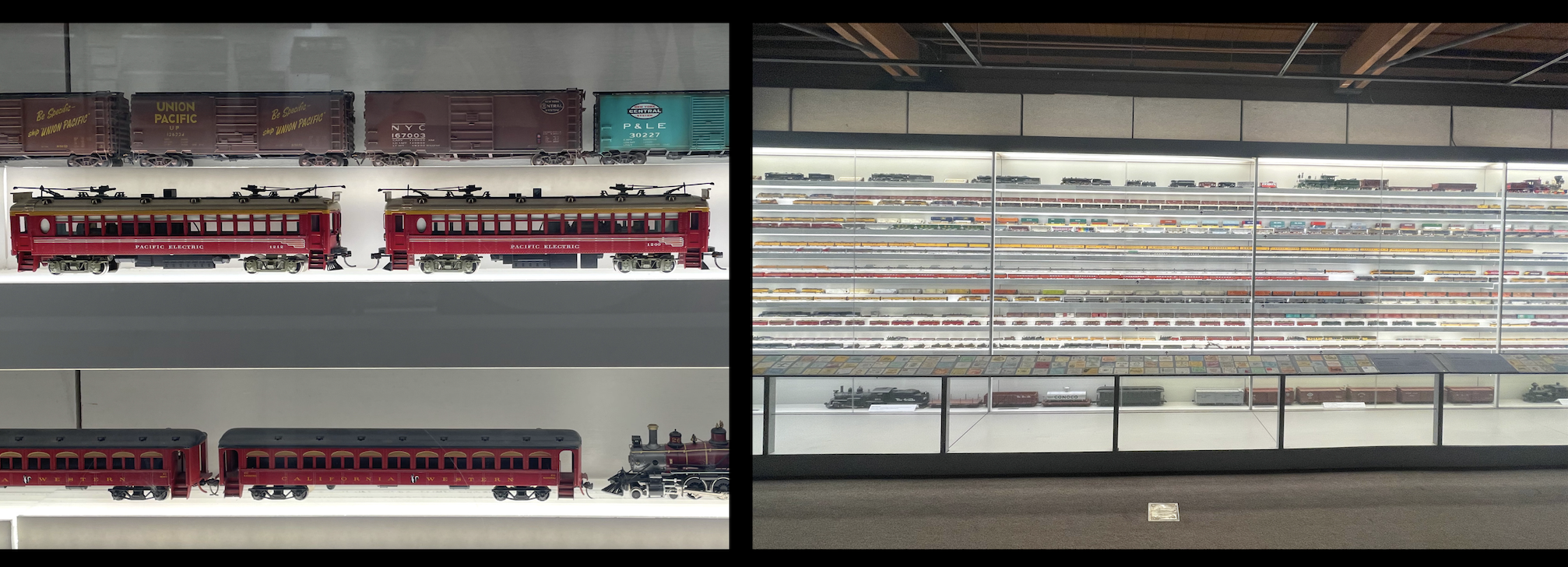
LA’s Pacific Electric Railway in Miniature
On the second floor, the wall of model trains is a quite a site for the model train aficionado. Somehow I spotted the Los Angeles’ Pacific Electric cars in this sea of trains. To the untrained eye, no one would know these miniature Red Cars represented a public transportation system that was once the largest in the county. I love finding bits of Los Angeles history outside of Los Angeles.
Modesta Avila & Other Women’s Stories:
This is probably no surprise, but I do read all the women’s stories in museum displays including the ones in the museum’s “Crossing Lines: Women of the American Railroad” exhibit.
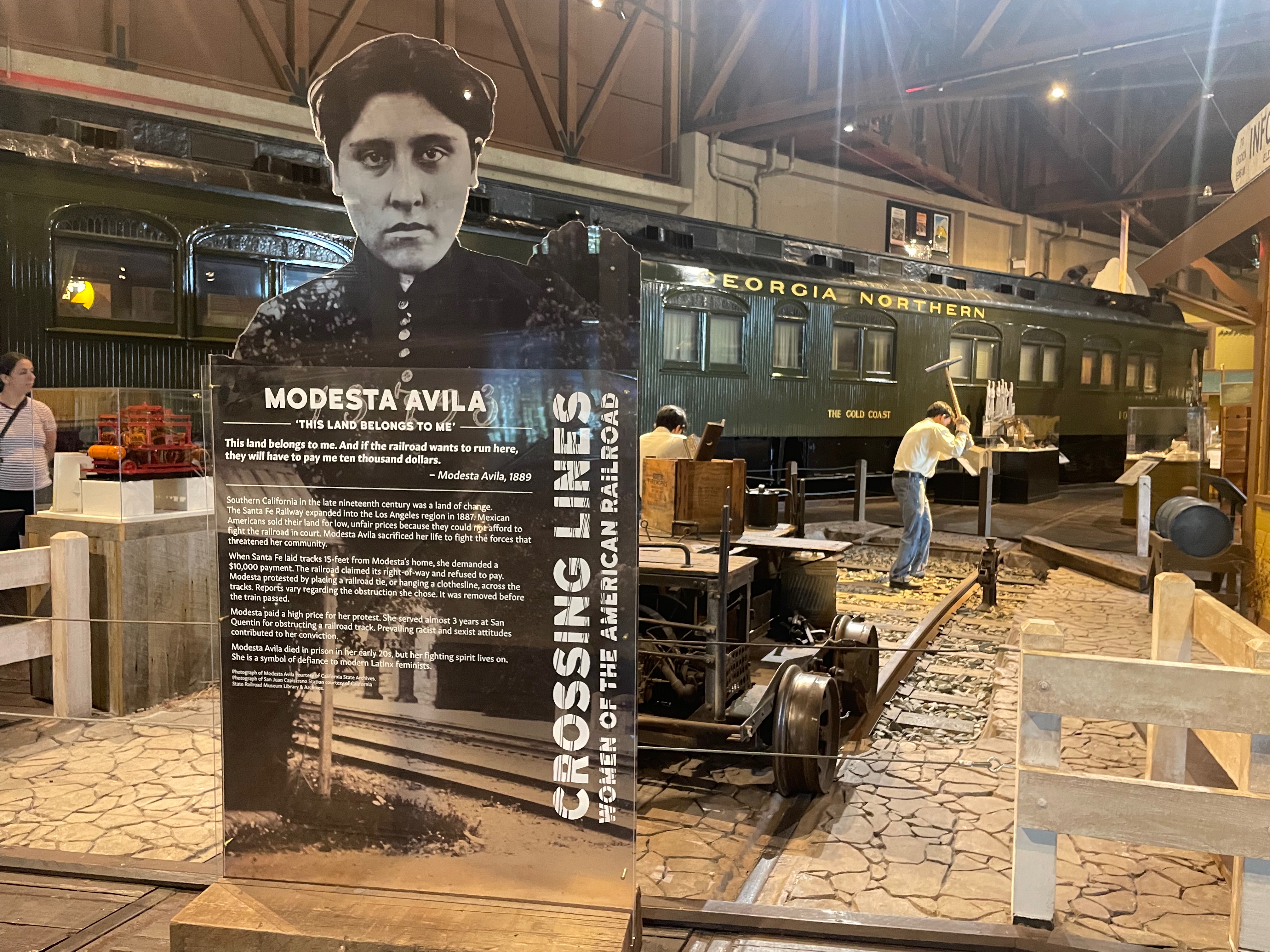
- Modesta Avila: As the Santa Fe Railroad made its way through her family’s land around San Juan Capistrano, Modesta Avila stood firm. She blocked the train tracks and added a sign that read “This land belongs to me. If the railroad wants to run here, they will have to pay me $10,000.” She became Orange County’s first felon when she was arrested and convicted for “attempted obstruction of train.” There is so much more to this story — see “Modesta Avila vs. the Railroad and Other Stories about Conquest, Resistance, and Village Life” by Lisbeth Haas.
- Olive W. Dennis: With two master’s degrees (in math/astronomy & civil engineering), Olive Dennis became the first female engineer hired by a major railroad when she went to work for the Baltimore and Ohio Railroad. To quote the exhibit, “For the next 31 years, she developed ways to make railroad travel more comfortable. Air-conditioning, footrests, reclining seats and stain-resistant fabric were all innovations of Olive W. Dennis.”
- The Railroadettes: During WW2, the Southern Pacific hired women to fill the vacancies left by men who enlisted in the armed forces. The Southern Pacific emphasized that these women were “Railroadettes” — not Rosie the Riveters. A quick search through old newspapers has me wondering if the SP sent out a press release in November 1942. Different newspapers across California all published the same headline and paragraph throughout November and December 1942: “Railroadettes Lend a Hand: To relieve the manpower shortage, Southern Pacific now has some 1600 women at work in its mechanical and store departments.”
“In its 159(+) years, this car looks its age. It has not been restored, so its life is on full display. Every crack, nail hole, and chip of paint has a story to tell.” — California State Railroad Museum.
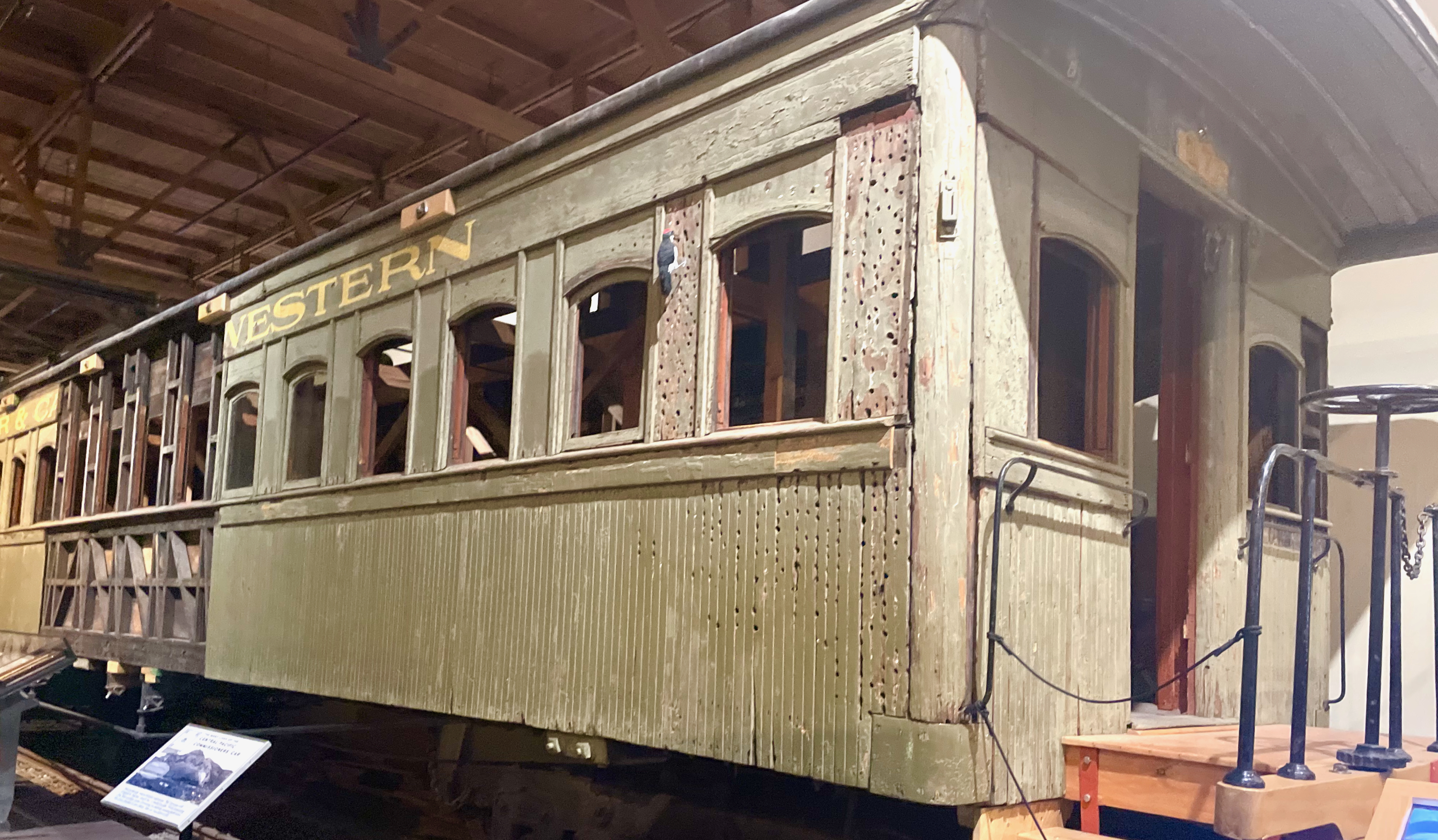
The Suffrage Special: The history of this railroad car, aka the Central Pacific Commissioners car, began with the Transcontinental Railroad in 1869 and ended in Hollywood (this car even made an appearance in Elvis’ first film Love Me Tender). In between these two events, the railroad car transported Nevada women to the state capitol to watch the Nevada State Legislature ratify the 19th Amendment.
It was pretty cool to be standing in front of this railroad car on May 10, 2025, as it’s the only railroad car left from the golden spike ceremony 156 years ago. All “Big Four” members spent time on this train car, either in 1869 or in the years after. When decommissioned, this railroad car was leased to Hollywood studios that eventually left it standing in a Malibu Canyon location (long enough for Malibu woodpeckers to leave their mark).
Considering its layers of history, this might be one of my favorite railroad cars in all of California.
Fine Dining on the Rails

Inside the museum’s Santa Fe Railroad dining car, the Cochiti, is an impressive display of the different china patterns used for different railroads. According to this exhibit, the fine china was heavyweight and institutional-grade in order to withstand the rigors of train service. This beautiful California Poppy design used by the Santa Fe Railway and Fred Harvey Houses has been reproduced for the museum and is available in its gift store. Sure wish Amtrak offered such service on its current lines.
I’m no train museum expert, but I was so impressed with this California State Parks facility. I could’ve spent the whole day wandering around this palace to railroad history. Clearly all the kids running in and out of the trains also had a good time — this is definitely a great air-conditioned spot for families.
In addition to Train Day, it was also Mother’s Day weekend. Grief appeared briefly while I was standing at the Gold Spike display. My mom and I had enough conversations about these ceremonial artifacts, that surely we would’ve spent time discussing this display along with all the others. We would’ve talked about Collis P. Huntington and the railroad dining exhibit in the Santa Fe Railway car. She would’ve reminisced about various train trips in her life and I would’ve probed her for more stories. After ten years, I’ve adjusted to the quiet ways grief is a part of my life. But in this moment, I could feel her absence loudly and deeply. Suppose that’s what happens when your mom was also your partner in Los Angeles/California history. Still, she would’ve loved that I spent Mother’s Day weekend, and Train Day, exploring this railroad museum.
* On May 10, 2025, Train Day happened to fall on the actual anniversary of the Transcontinental Railroad. Usually Train Day is the Saturday closest to the May 10th anniversary.
**Actually, Sacramento’s big celebration of the completion of the Transcontinental Railroad was held on Saturday, May 8, 1869. There was a parade featuring Central Pacific officials, machinists, blacksmiths, coppersmiths, firemen, businessmen and school children…but no Chinese workers? Not surprisingly, several businesses placed ads in the Sacramento Bee — “The 🚂🚂🚂 Completed! And this Great Event is properly celebrated at Merrill’s Pioneer Lamp and Crockery Store” (a 19th-century version of emojis included). An excerpt from the Sacramento Bee:
“Sacramento was beautifully illuminated last Saturday evening. J Street presented a grand appearance and looked like a fairy land. The sidewalks were so crowded that pedestrianism [sic] was attended with some difficulty. It was a late hour when the greater portion of the crowds south their homes and retired to rest after the pleasures and excitement brought about by the Grand Pacific Railroad Celebration,” Sacramento Bee (May 10, 1869).
 Victoria Bernal
Leave a comment