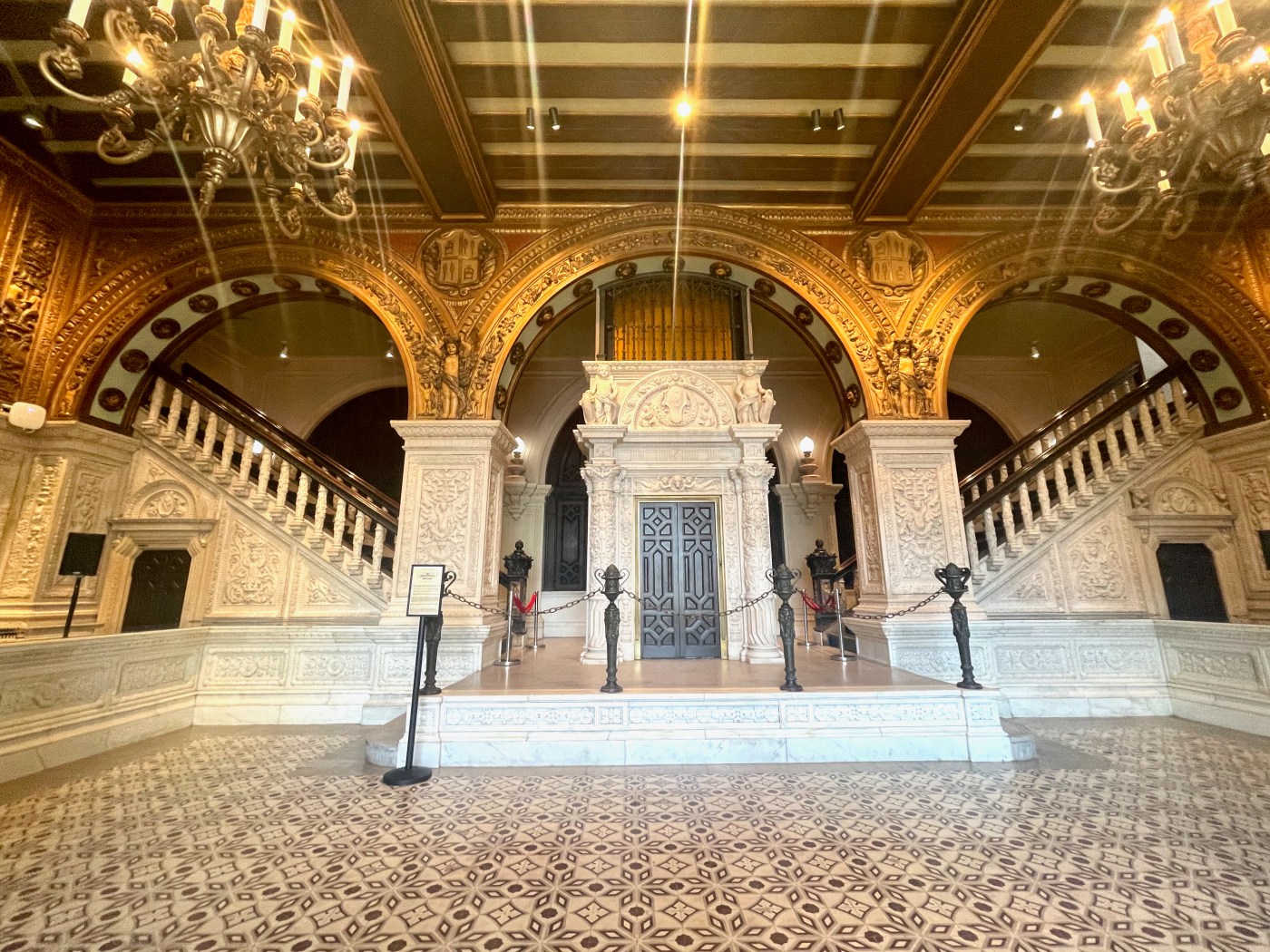
Thanks to the Santa Monica Conservancy, I finally toured through the Los Angeles Herald Examiner Building, now ASU’s Los Angeles campus. Julia Morgan (1872–1957), California’s first woman architect, designed this Mission Revival building at 11th and Broadway for William Randolph Hearst (1863–1951) about six years before designing his estate in San Simeon, Hearst Castle.
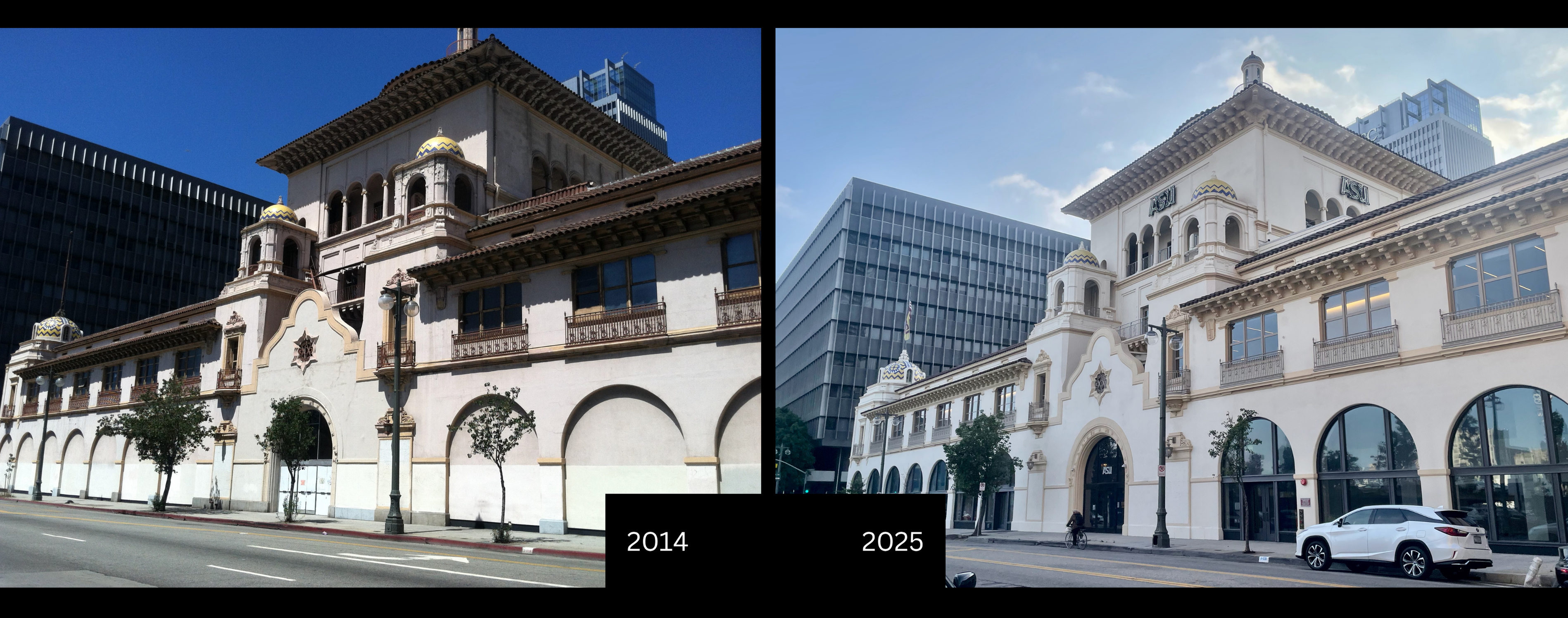
Ten (or so) years ago, this Julia Morgan landmark served as the stopping point for my women’s history walks in downtown. And when we stopped at 11th and Broadway back then, we just looked past the building’s boarded up windows, broken signs and tagged walls to imagine the hum of newspaper activity that operated within its walls 100 years ago. Like many, I was thrilled for this landmark’s glow up in 2021, and even more thrilled to finally step inside in 2025.
Much has already been written about the history of the Herald Examiner Building (see here and here), plus a new coffee table book is in the works (according to our ASU tour guide). But I was curious about a few other topics related to this building, so am sharing some of my research from digging into this history.
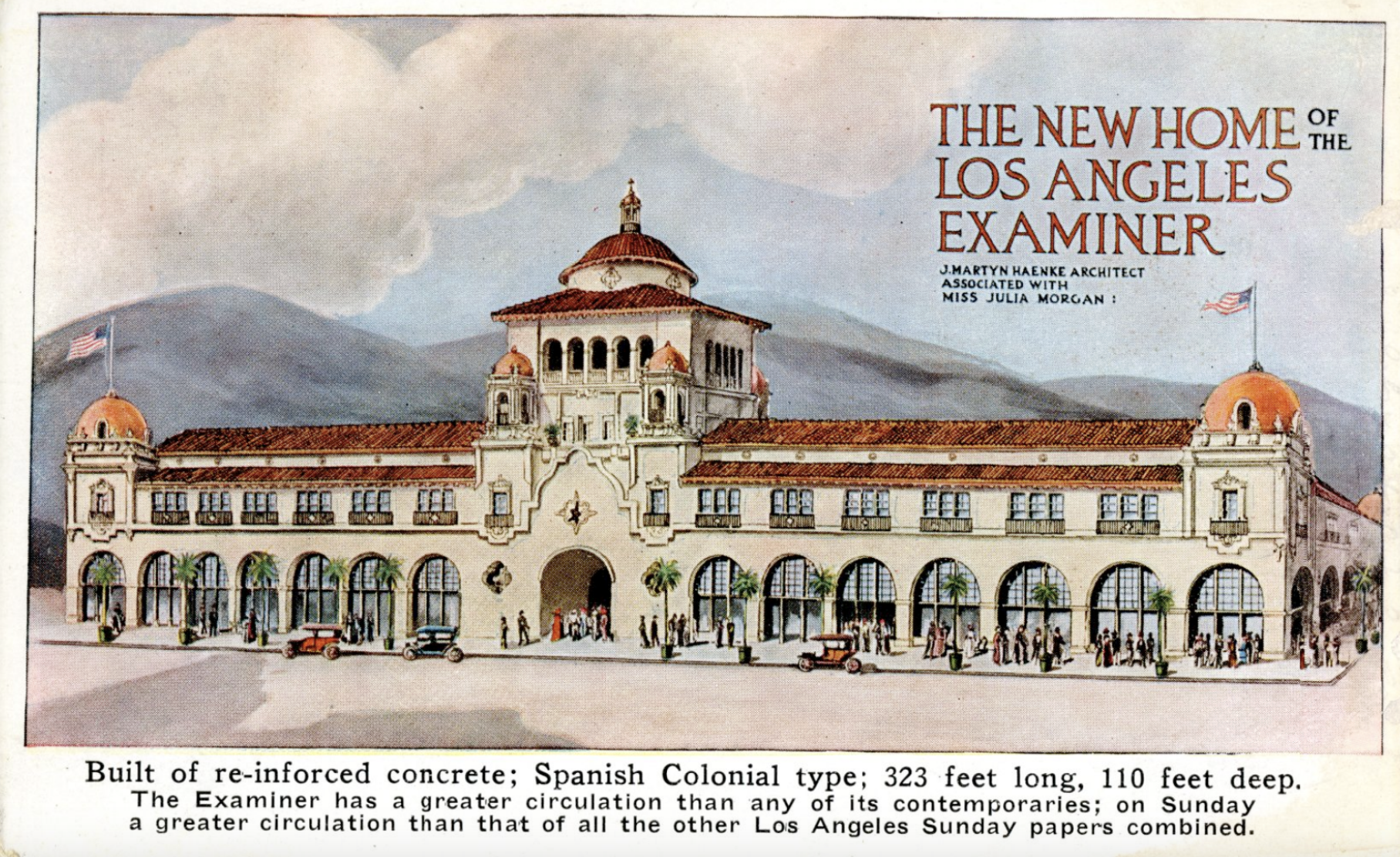
For almost 50 years, this building was known as the Los Angeles Examiner Building. It became the Herald Examiner Building in 1962, when the Examiner merged with the Los Angeles Herald-Express, also owned by the Hearst Corporation. Also, the names of architects J. Martyn Haenke and W.J. Dodd appear on some documents related to this building but, according to the Historic Resources Group, Hearst always referred to Julia Morgan as the architect. It’s suggested that she may have worked with them to fulfill local building requirements. Postcard comes from SDSU’s University Library’s digital collections.
Three Directives of the Los Angeles Examiner Building
William Randolph Hearst issued three directives for the design of this building:
- The building should be the largest building in the world devoted exclusively to the production of a newspaper.
- The building should be a worthy and substantial addition to the rapidly expanding business heart of Los Angeles.
- The building should typify architecturally the romance and history of Southern California, whose early life and traditions were derived from old Spain.
It’s safe to say that Julia Morgan’s design met all three criteria, though not sure it was the largest newspaper building IN THE WORLD in 1915. While one could dismiss such a directive as Hearst hyperbole, I was curious how the Examiner Building measured up against others of its ilk. At 103,500 square feet, the Examiner had the largest newspaper building in Los Angeles at the time of its opening. The Los Angeles Times‘ new building (opened in 1912) had 18,500 square feet.* The beautiful Los Angeles Evening Express building designed by Morgan, Walls & Clements in the 1920s (and demolished in the 1960s) was built with 27,000 square feet. In 1935, the Times’ new Art Deco offices surpassed the Examiner with a floor space of 300,000 square feet.
Cornerstone of the Examiner Building and Southern Edge of Downtown
In the summer of 1913, Hearst stood among civic, religious and business leaders for the ceremonial laying of the cornerstone. The Burbank Review reported that 12,000 attended this construction milestone, while Hearst’s own San Francisco Examiner boasted 15,000 were in attendance. A competitor to the Examiner, the Los Angeles Times just reported that “a large crowd” attended. Either way, a lot of people made a lot of hoopla that day in this then-quiet stretch of downtown. An excerpt from Hearst’s talk on that day in 1913:
“I take pleasure in the success of ‘The Examiner’ first because I am a Californian and take pleasure in the success of everything Californian. I was not born in Los Angeles, but I was born in California. A man is a Los Angelean no matter on what street in Los Angeles he is born or lives and a man is a Californian no matter in what part of California he is born or lives. We Californians are learning more and more that we are all bound together by the firm bonds of fraternity and that the combined successes of all as individuals make the complete success of all as a community,” William Randolph Hearst.
Cameramen took “moving pictures” for newsreels that were later shown in theaters like Long Beach’s Wigwam Theatre. One article suggested these “moving pictures” were sealed in the cornerstone, along with a California flag. Does this footage still exist? If so, where is it?
 Moving Day at the Examiner
The official opening of the Examiner Building is believed to be January 1, 1915. So I found it curious that this Los Angeles Graphic editorial suggested the Examiner staff moved into the building in the Fall of 1913. Having posted some version of a “This Day in LA History” for 16 years, I’m well-versed in the splitting of hairs when it comes to the many milestones of a building. But I’m less interested in the exact move-in date and more interested in this hilariously sarcastic tone from the Los Angeles Graphic about the move.
The new Examiner Building also served as a cornerstone to the southern edge of downtown as Hearst’s gravitation pull attracted more commercial development to this stretch of the neighborhood. At the time, nearby blocks were mostly populated with small hotels, churches, homes, and flats, though business was inching south. Property ads in local newspapers promoted the sites’ proximity to Hearst’s new structure.
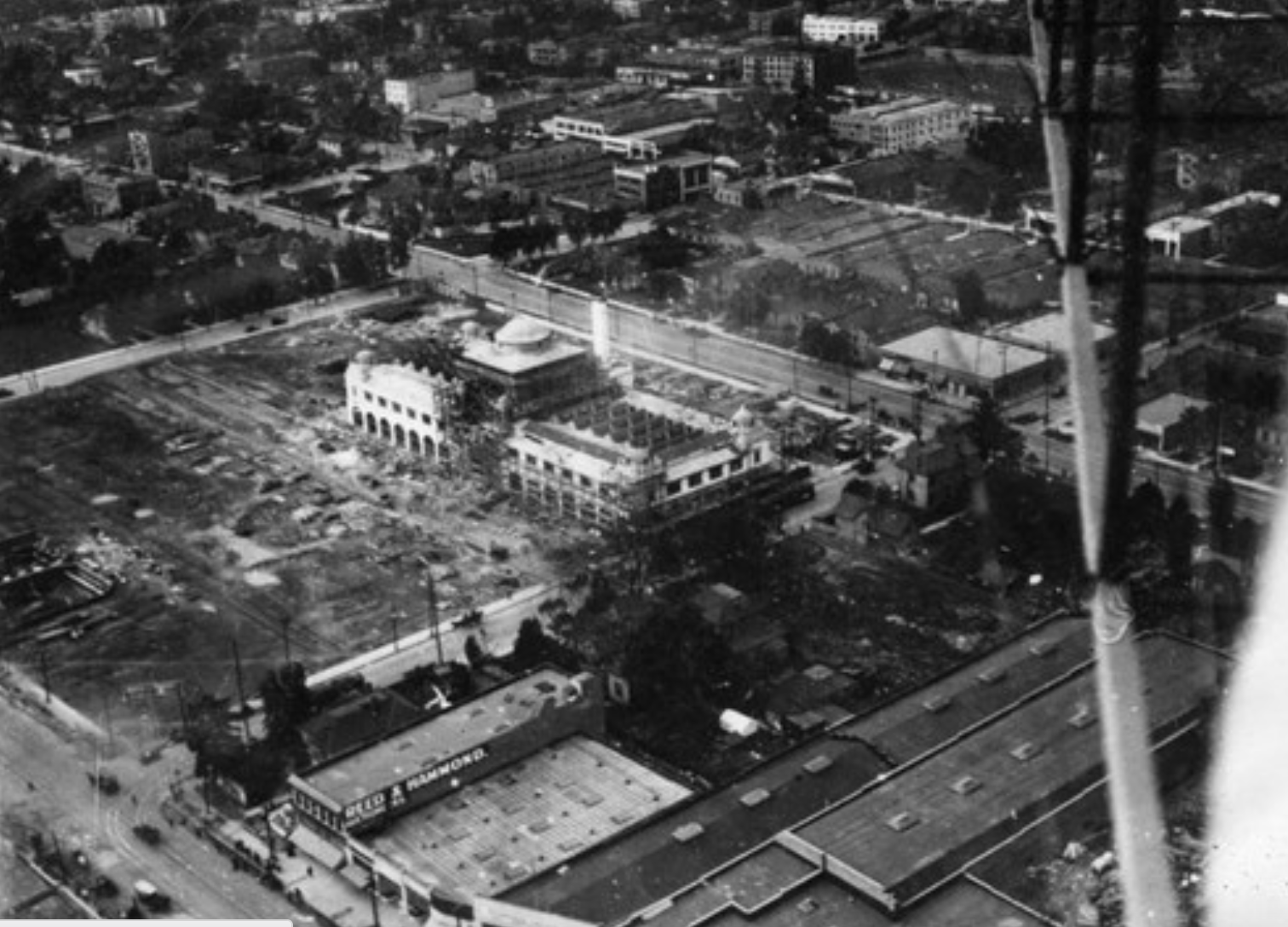
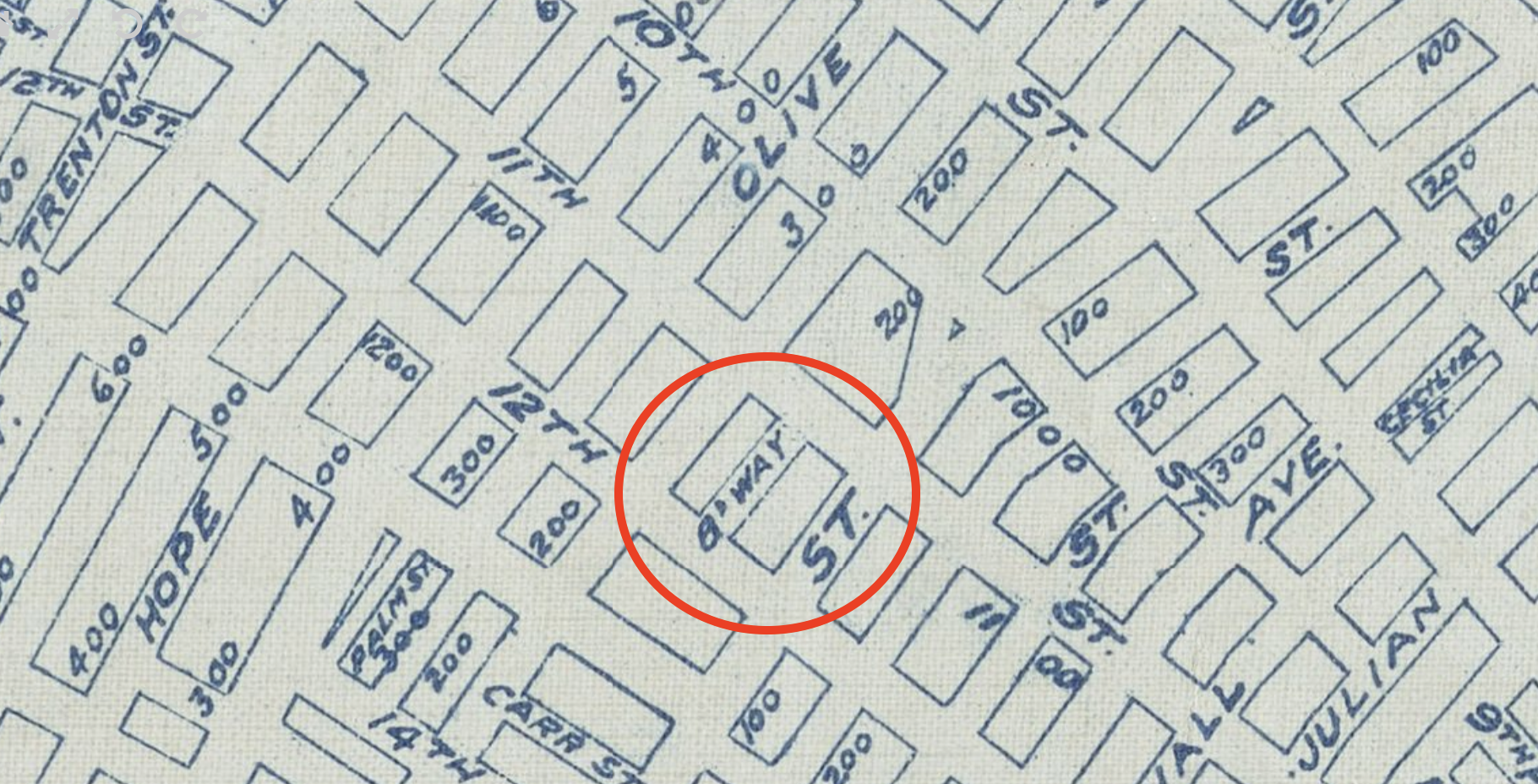
When Hearst purchased this parcel on Hill and 11th Street, Broadway did not intersect with 11th Street because it turned into Main Street. When announced in 1913, the plans for the Examiner Building included a frontage on Broadway that did not exist at the time. My sense is that Hearst and his team built the street and then gave the right of way to the City of Los Angeles, but I have yet to confirm that with documentation. Several years would pass before Broadway extended seamlessly to Pico (see KCET article on the history of Broadway Place). Map (1917) courtesy of the Los Angeles Public Library.
Huntington Hall School for Girls
The parcel at 11th and Hill Street was the site of the exclusive Huntington Hall School for Girls. In 1906, educator Florence Housel (1868–1920) 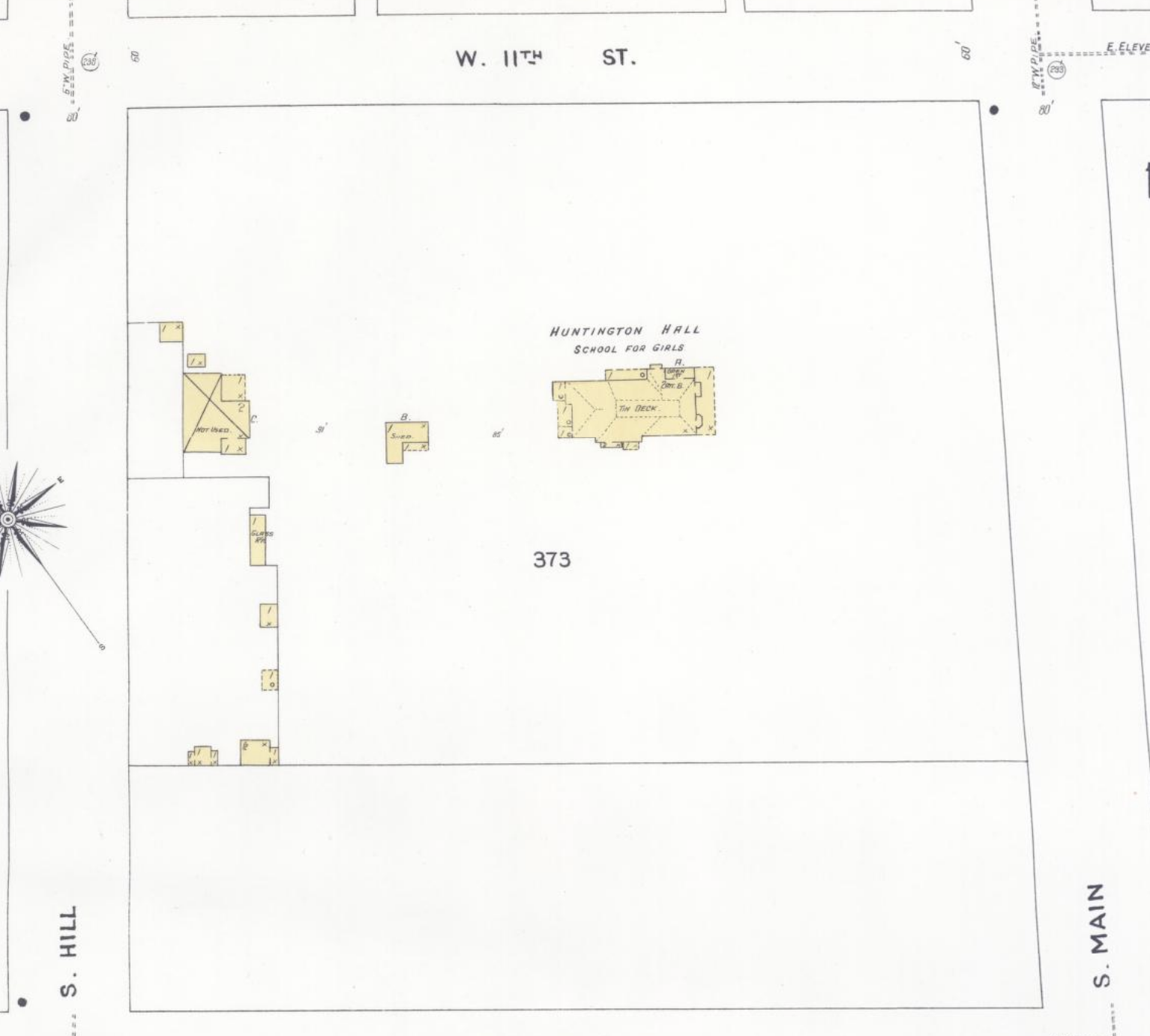 leased the property from Henry Huntington (1850–1927) who managed this estate — and its old mansion — once owned by Mrs. Emeline Childs (1838-1935). The widow of Ozro W. Childs had already moved to her beautiful West Adams home by this time.
Surrounded by the beautifully-manicured gardens, Housel’s “eastern school for girls in the West” transformed the old Childs’ mansion into classrooms as well as dormitories, since half the students lived on site. A graduate of Wellesley College, Housel was adamant that this was not a “finishing school” that instructed women in “superficial finishing and effete culture.” After returning from her eastern trip in 1910, Housel told the LA Times that “educators are protesting against the training of young women in extravagant and spendthrift habits. They are a ruin to the womanhood of the country.” Housel’s trips to the east and abroad helped ensure that the school’s curriculum met the entrance requirements of Wellesley, Smith, Vassar, Bryn Mawr, La Sorbonne and the University of California.
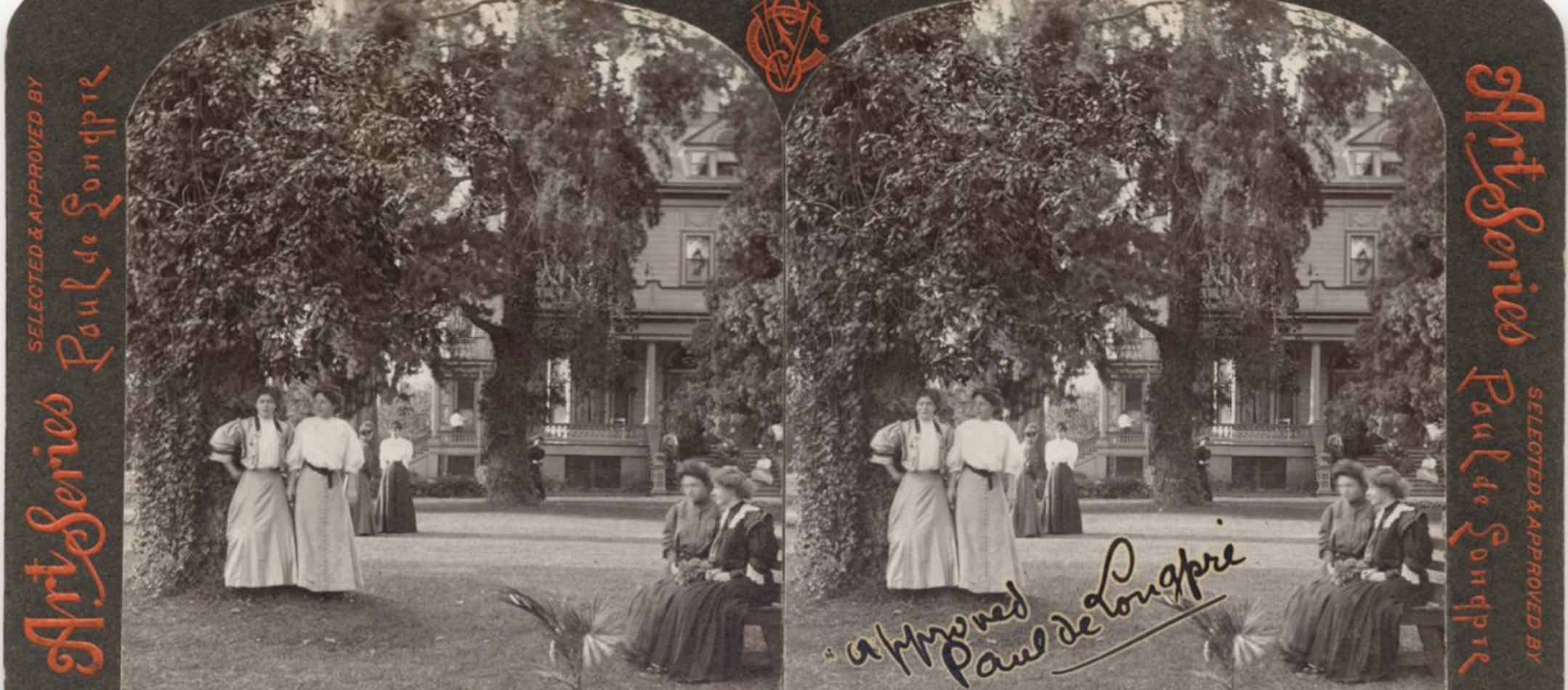
In 1911, the school moved to South Pasadena as it outgrew the site (and the site outgrew the school). The Los Angeles Times took a slight nostalgic tone when reporting the move: “The present site of the school, with its beautiful grounds, will soon be incorporated into the skyscraper zone that is sweeping southward with the swing of the commercial advance and this, almost the last of the landmarks of a generation that has passed, will soon be unrecognizable.”** Photo of Huntington Hall courtesy of the California State Library.
Herald Examiner on Big & Little Screens
It was another end of an era when Herald Examiner shut its doors in 1989, but fortunately a new chapter ushered in by location manager Brian Brosnan saved it from possible demolition. According to this Hollywood Reporter article, Brosnan, founder of Hollywood Locations, suggested that the Hearst Corporation open the space to filming. The site herald-examiner-los-angeles-filming-location.com no longer works (unless you use the Wayback Machine) but one can find some of those movies, TV shows and music videos filmed at the Herald Examiner on its Facebook page.
Perhaps my favorite TV cameo for the Herald Examiner Building comes from the spy show Alias, when this ornate lobby was turned into a cowboy bar in Moscow. I can only imagine what architect Julia Morgan would think if she saw actress Jennifer Garner jump off the electronic bull in front of William Randolph Hearst’s private elevator…though surely Hearst’s girlfriend and actress Marion Davies would’ve loved it. 🙂
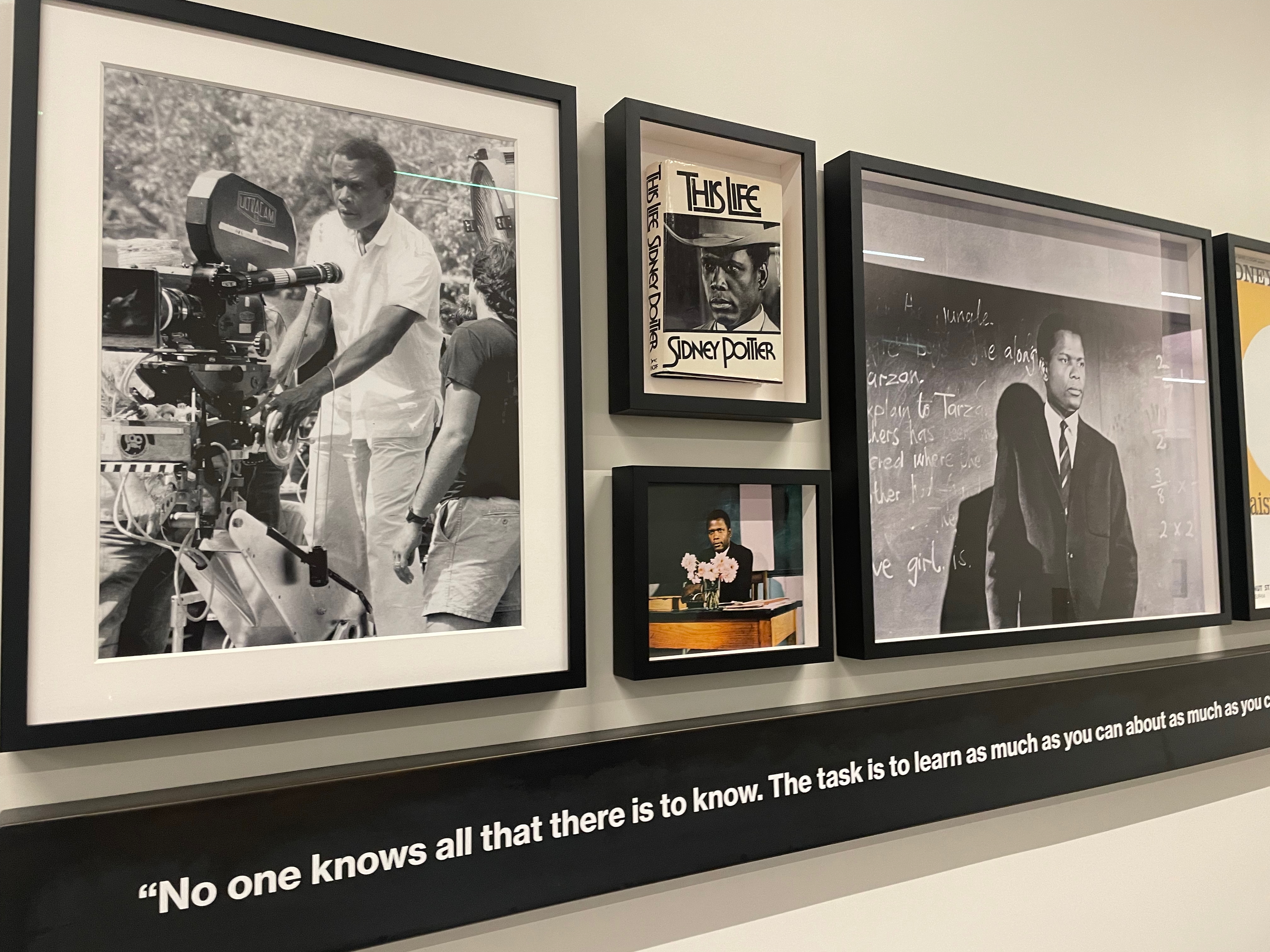
While touring around the ASU California Center, I was impressed with all the student resources for the Walter Cronkite School of Journalism and Mass Communication and Sidney Poitier New American Film School. Thinking about this next generation of storytellers moving through this storied structure had me wishing the same 1913 wishes of Reverend Donohue who spoke at the cornerstone laying 112 years ago:
“Our one hope and good wish and prayer is that the influence—the great influence that [William Randolph Hearst today’s media-maker] so surely holds—may ever be devoted towards fighting evil in high places, defending the weak, and forwarding sound morality the world over.”
* The Los Angeles Times building that opened in 1912 was either 18,500 feet or 13,500 square feet. The bleeding text in the 1912 newspaper made it difficult to read.
** There is a very tragic end to this school and its founder that I chose to omit because this sad story deserves its own post.
 Victoria Bernal
Leave a comment